
It's me, not you. Well, no, it's both of us.
Actuaries discuss the financial impact of changing benefits, policies, or populations. Early in these discussions, a common question is, "Is this item material?"
It is a well-meaning question. It is also incomplete.
Materiality is not an attribute of the adjustment itself. Contrast that with Excel and a cell's color: you can use Excel VBA to inspect the cell's attributes, and everyone can see and agree that the cell's color is highlighter yellow. Even with that level of objectivity, you cannot inspect whether an adjustment has the attribute "material."
Actuarial Standard of Practice (ASOP) No. 1, Introductory Actuarial Standard of Practice, Section 2.6:
"'Materiality' is a consideration in many aspects of the actuary’s work. An item or a combination of related items is material if its omission or misstatement could influence a decision of an intended user. When evaluating materiality, the actuary should consider the purposes of the actuary’s work and how the actuary anticipates it will be used by intended users. The actuary should evaluate materiality of the various aspects of the task using professional judgment and any applicable law (statutes, regulations, and other legally binding authority), standard, or guideline. In some circumstances, materiality will be determined by an external user, such as an auditor, based on information not known to the actuary. The guidance in ASOPs need not be applied to immaterial items." (Emphasis added)
It's a good definition. Materiality is whether an intended user, or what we'll call a stakeholder, including the actuary themselves, would change their decision if an item, or combination of related items, changes via inclusion, omission, or misstatement. Yet the definition hides a layer that connects the item to the decision: the stakeholder's utility function.
Hey, Where's the Cream Filling?
Start with the decision. Does my decision change if the item changes (\(\Delta x\))?
$$ \text{material}_i(x, \Delta x) \iff d_i(x + \Delta x) \neq d_i(x) $$
\(i\): The stakeholder, or intended user as the ASOP might call them. You also can be an \(i\).
\(x\): The item's reported value.
\(\Delta x\): The change in the reported item (inclusion, omission, or misstatement). It can be the sum of many items.
\(d_i(\cdot)\): Stakeholder \(i\)'s decision as a function of the item.
\(\iff\): "if and only if," which is a fancy way of saying that knowing something about one side is enough to infer what happened on the other side; they share the same truth value (both true or both false).
\(\neq\): The decision after the change is a different decision than before.
The above decision comes from the stakeholder's preferences, which usually can be encoded as a utility function, and then what expected utility they get if they take different actions. The item in question might concern you and change your expected utility. Still, if it doesn't change your decision, it doesn't count as material to you.
$$ d_i(x) = \arg\max_{a \in A_i} \text{E}\big[u_i(a, \tilde{\theta}) \mid x\big] $$
\(a\): An action—decision—available to the stakeholder.
\(A_i\): The actions stakeholder \(i\) could take.
\(\tilde{\theta}\): Is a parameter, an unknown outcome, and can be described by a distribution. For example, what costs will be in the future. If its distribution is conditioned on \(i\)'s background information, the distribution is \(i\)'s belief.
\(u_i(a, \tilde{\theta})\): Stakeholder \(i\)'s utility from taking action \(a\) given the outcome \(\tilde{\theta}\).
\(\text{E}[\cdot \mid x]\): The expected value given the reported item. The probability-weighted average.
\(\mid\): Conditional probability ("Given"); that is, you know something. Remember, all probability is conditional probability. You know things about the world.
\(\arg\max\): The action, \(a\), that makes the expected utility largest.
You have your belief about what the future holds. You know your preferences. You have actions you can take. So take the action that is expected to give you the most utility. If this action changes because you learn about the item, we call the item material to you because your belief and decision change when you learn about it, and a utility function connects belief, decision, and the item.
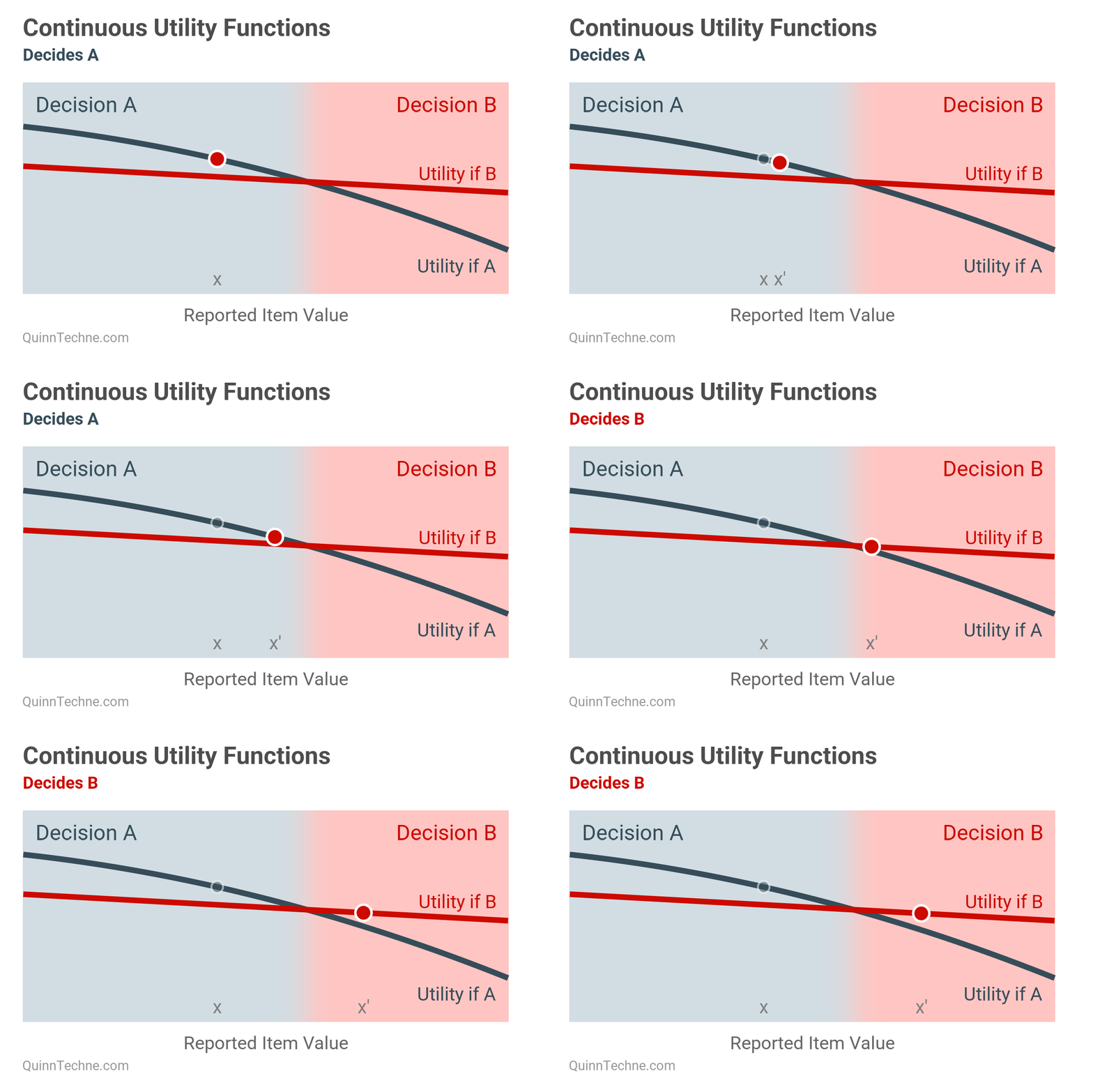
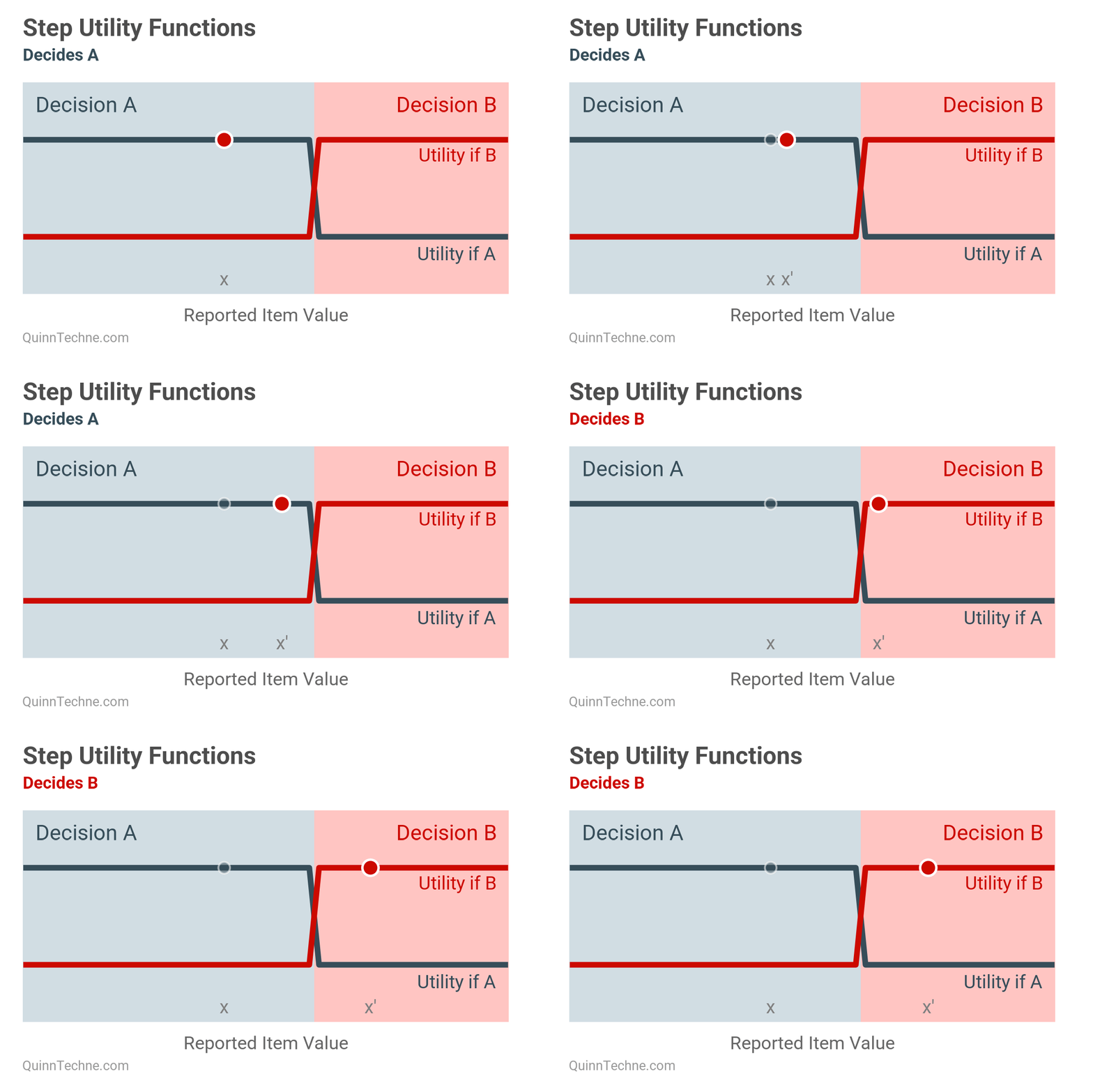
Decisions and preferences are not always straightforward. Sometimes the boundary between deciding A versus B is fuzzy, which is why an explicit utility function can be helpful.
While some utility functions are continuous (top chart), others are step functions (bottom chart). A regulator's preference behaves like a step: compliance is the preference, high utility for calling noncompliant things noncompliant and high utility for calling compliant things compliant. The item's size is usually irrelevant; it's just, "Did you meet the regulation?" For regulation and standards of practice, it's clearer where that decision-flipping boundary is. But for a stakeholder with a private boundary, the actuary has to estimate where that boundary lies.
"Could" Is a Probability
If materiality is about decisions, what does "could influence" add from the ASOP?
First, the actuary has their belief about the future, which is a distribution conditioned on their prior, background information, and probably not the exact beliefs the stakeholder has. This can be true even if the actuary and stakeholder see the same evidence. Because each starts with their own background information, they both update on the same evidence. However, they may update by different amounts (or in different directions!) and end up with updated distributions, posterior distributions, that still noticeably differ. Thus, the actuary is estimating a stakeholder's belief if they don't think it's the same as theirs.
Second, the actuary doesn't know the stakeholder's utility function. So it's inferred and approximated, usually in terms of incentives and behaviors. Watching a stakeholder change their decision gives you some insight into where their decision boundary lies. But you won't know how far away it is from the item you changed, just that you crossed it. However, the stakeholder is probably only seeing one version of the item. It is the actuary running a counterfactual in their head, based on an estimate of the stakeholder's utility function, to compute whether the stakeholder might change their decision. It looks like, "If I change this item, then there's an X% chance the stakeholder changes their decision."
Regulation and ASOPs at least simplify where the boundary likely is within regulators' utility functions. But the actuary still faces interpretation uncertainty. If you're lucky, you might be able to ask the stakeholder for their preference, and they can articulate it. But don't count on it. And so we live in a world of "could," estimates on estimates. Isn't being an actuary great?
So What You're Saying Is...
The next time you hear, "Is the item material?", translate to, "To the actuary, does this adjustment change their decision about the actuarial soundness of the rates per federal regulation?" or "To the regulator, does this adjustment change their decision about whether the rates comply?" and so forth. Material is not an attribute; it's whether someone's decision changes—what is material to whom?
Actuarial Standards Board. (2013, March). ASOP No. 1: Introductory Actuarial Standard of Practice (Doc. No. 170). Retrieved September 12, 2026, from https://www.actuarialstandardsboard.org/wp-content/uploads/2013/10/asop001_170.pdf
Calculations and graphics done in R version 4.3.3, with these packages:
Wickham H, et al. (2019). Welcome to the tidyverse. Journal of Open Source Software, 4(43), 1686. https://doi.org/10.21105/joss.01686
Qiu Y (2024). showtext: Using Fonts More Easily in R Graphs. R package version 0.9-7. https://CRAN.R-project.org/package=showtext
Ooms J, Lesiński K (2025). gifski: Highest Quality GIF Encoder. R package version 1.32.0-2. https://CRAN.R-project.org/package=gifski
The views and opinions expressed in this article are those of the author and do not represent the official policy or position of any employer, organization, or entity. This article is for informational and educational purposes only and does not constitute professional actuarial advice.
Generative AIs like Anthropic's Claude Fable 5.1 were used in parts of the writing review and coding. The author did the Suminagashi cover.